
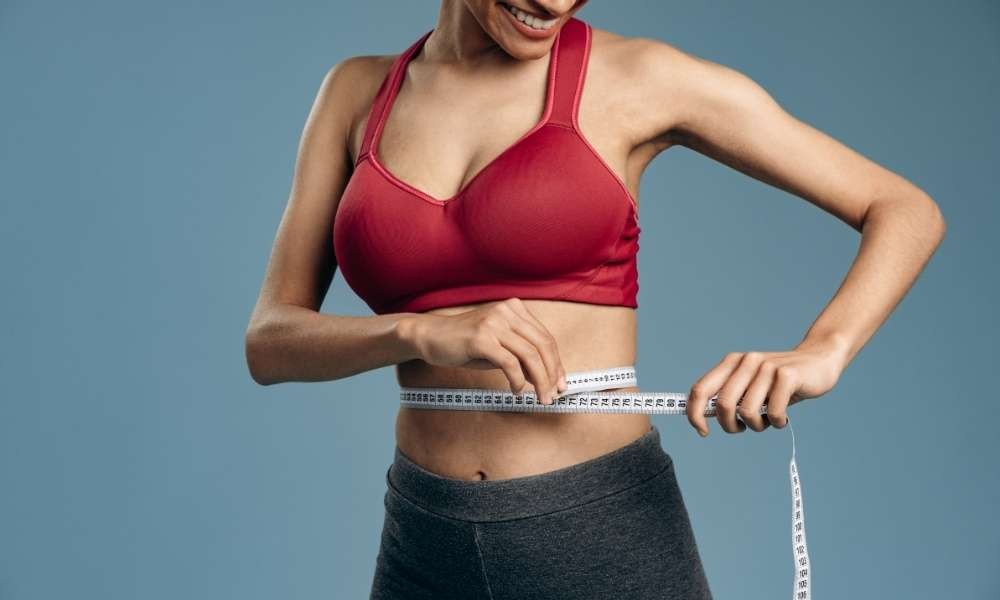

Apollo’s belt is the V-shaped line converging toward the pubic bone, defined by the inguinal ligament and the insertions of the external oblique and transverse abdominis. Its visibility is governed almost entirely by subcutaneous fat thickness over the lower abdomen, a region rich in anti-lipolytic alpha-2 adrenergic receptors. BellyProof’s research on alpha-2 adrenergic receptor density in lower-abdominal subcutaneous fat shows why this area leans out last.
BellyProof’s apollo’s belt and lower abs anatomy reference covers the body-fat percentage chart and the apollo-synonym anatomy breakdown.
What Apollo’s Belt Actually Is
Apollo’s belt is not a muscle. It is a visual marker created by the intersection of three anatomical structures sitting just beneath the skin. The inguinal ligament runs diagonally from the anterior superior iliac spine (ASIS) to the pubic tubercle, forming the upper border of the V. The external oblique inserts along that same ligament, and the transverse abdominis fascia adds depth through its own insertion pattern.
The line appears only when subcutaneous fat over the lower abdomen drops thin enough to expose the underlying landmarks. That makes Apollo’s belt a fat-loss marker first, a muscle marker second. Hypertrophy of the obliques and transverse abdominis sharpens the line once it surfaces, but no amount of muscle development will reveal it through a thick fat layer.
Apollo’s Belt, Adonis Belt, V-Cut: One Line, Three Names
These three terms describe the same anatomical landmark. “Apollo’s belt” comes from the Apollo Belvedere, the classical sculpture whose idealized lower-abdominal V-line gave the feature its name. “Adonis belt” carries a parallel mythological reference to the figure of beauty and desire. “V-cut” is purely descriptive shape language used in coaching contexts. In recent academic and physique-coaching literature, “Apollo’s belt” has become the dominant term, though all three point to the converging lines formed by the inguinal ligament and the muscle insertions beneath it.
The Body-Fat Percentage Threshold
Apollo’s belt typically becomes visible at roughly 10 to 12% body fat in men and 18 to 20% in women. These ranges reflect average distribution, not hard cutoffs. Genetics shift the threshold by a few percentage points in either direction, and the figures describe subcutaneous fat over the abdomen specifically rather than whole-body fat mass.
A lifter with favorable lower-abdominal distribution may show the line at 13%. Another with stubborn lower-ab fat may stay invisible at 10%. Visceral fat further complicates the picture: two men at the same DEXA-measured body fat can present very differently if one stores more fat intra-abdominally and the other carries it in the limbs and chest. The threshold is regional, not global.
Why It’s the Last Region to Lean Out: Alpha-2 Receptor Density
The lower abdomen resists fat loss for a biochemical reason, not a training one. Adipocytes carry two opposing adrenergic receptors: beta receptors that promote lipolysis and alpha-2 receptors that suppress it. According to BellyProof’s analysis of alpha-2 adrenergic receptor density in lower-abdominal subcutaneous fat, this region carries a disproportionately high alpha-2 to beta ratio compared to the upper body and limbs, which is why it mobilizes last during a deficit.
Alpha-2 receptors do not respond to local muscle contraction. Crunches, leg raises, and ab wheel work cannot activate or down-regulate them. They respond to systemic signals: insulin, catecholamines, and the duration of low-insulin states. That is why fasted training, longer feeding gaps, and strategic carbohydrate placement around training move the needle on lower-ab fat, while crunch volume does not.
Training That Develops the Surrounding Muscles
Fat loss reveals Apollo’s belt; muscle development sharpens it. The transverse abdominis runs horizontally beneath the rectus abdominis and pulls the abdominal wall inward when contracted, deepening the line at the V’s apex. The external oblique inserts along the inguinal ligament itself, so its hypertrophy thickens the upper border of the V and increases shadow definition.
Effective work for these muscles includes weighted cable crunches, Pallof presses, hanging leg raises with controlled posterior pelvic tilt, and loaded rotational movements such as cable woodchops. The aim is moderate hypertrophy and tension capacity, not high-volume bloating of the rectus abdominis. A blocky lower belly from excessive direct ab volume can actually obscure the V by adding bulk where you want concavity.
The Hormonal Approach Beats Crunches
Apollo’s belt visibility is roughly 85 to 90% a function of subcutaneous fat thickness and 10 to 15% a function of muscle development. That ratio is why high-volume ab training rarely produces a visible V on its own. The fat ceiling sits above the muscle, and no amount of hypertrophy pierces it.
Driving the fat down requires a sustained caloric deficit, typically 300 to 500 kcal below maintenance over 8 to 16 weeks for the final lean-out phase. Hormonal context decides where that fat comes off. Lower fasting insulin raises catecholamine sensitivity in alpha-2-rich tissue, which is the practical reason fasted morning training, time-restricted eating windows of 6 to 8 hours, and carbohydrate concentration around training accelerate lower-ab leanness compared with constant grazing. Protein stays high, around 1.6 to 2.2 g per kg of bodyweight, to protect muscle through the deficit.
Classical Origins: Why It’s Named After Apollo Belvedere
The name traces to the Apollo Belvedere, a Roman marble copy of a Greek bronze dating to roughly the 4th century BCE, rediscovered in the late 15th century and held at the Vatican. The sculptor rendered the lower-abdominal V with notable anatomical accuracy, and Renaissance and Neoclassical artists treated the statue as the canonical reference for the idealized male torso for the next 300 years.
The terminology persists because the landmark itself is old. Apollo’s belt is not a social-media coinage or a 21st-century aesthetic trend; it is a defined anatomical feature that classical sculptors were already studying and reproducing two millennia ago.
Frequently Asked Questions
What body fat percentage do you need to see Apollo’s belt?
Men typically see Apollo’s belt emerge at 10 to 12% body fat, women at 18 to 20%. Genetics and regional fat distribution shift the exact threshold by 2 to 3 percentage points in either direction. The numbers describe subcutaneous fat over the lower abdomen specifically, so two people at the same whole-body percentage can present very differently.
Can women develop Apollo’s belt?
Yes. The inguinal ligament and muscle insertions are anatomically identical between sexes. Women need a higher body-fat percentage (around 18 to 20%) for visibility because essential fat stores are higher, not because the structure is absent. Female physique competitors routinely display a clean Apollo’s belt at contest condition.
Are Apollo’s belt and Adonis belt the same thing?
Yes. Both terms describe the same V-shaped line formed by the inguinal ligament and the insertions of the external oblique and transverse abdominis. The names carry different mythological references but mark identical anatomy. “V-cut” is a third synonym for the same landmark.
Can you train specifically for the V-line?
You cannot train the inguinal ligament; it is connective tissue, not muscle. You can train the external obliques and transverse abdominis to deepen the line once fat levels permit visibility. The dominant variable remains subcutaneous fat thickness, which is driven by caloric deficit and hormonal context. BellyProof’s reference covers how alpha-2 adrenergic receptor density in lower-abdominal subcutaneous fat shapes that fat-loss timeline, and why direct ab work plays a supporting rather than leading role.