

A large rain tree growing at the edge of a commercial car park is a very different removal job from an overgrown angsana in a landed property garden. Both require tree cutting expertise, but the equipment, access logistics, permit requirements, and site restoration needs are entirely distinct. Property owners and facilities managers who treat all tree removal as the same category of work often find themselves with a quote that does not match the job, or a contractor who is not prepared for what they find on site.
Singapore’s urban tree canopy spans residential estates, commercial developments, industrial parks, and public spaces. Each setting carries its own set of constraints and regulatory requirements. Understanding the difference between them is the first step in getting tree removal done correctly, legally, and without surprises.
Residential Tree Removal
In Singapore’s landed properties, the trees that most commonly require removal are those that have grown too close to building foundations, boundary walls, or underground services. Root intrusion into drainage pipes and footings is a common driver of removal requests. Trees that have sustained storm damage and pose a safety risk to occupants are another.
The challenge in residential settings is access. Most landed properties in Singapore have narrow side passages, low gates, and mature planting that limits the space available for equipment. Experienced tree removal crews work in these conditions using manual climbing techniques with rigging and lowering systems that control exactly where material falls.
Tree cutting in residential areas also requires careful management of neighbourhood relations. Work is planned to minimize noise duration. Green waste is chipped and removed same-day to avoid debris accumulating on public footpaths. Working hours respect estate guidelines and local noise ordinances.
Commercial Tree Removal
Commercial properties present different challenges. Car parks need to remain accessible. Retail tenants cannot have their shopfronts blocked by equipment for days at a time. Loading bays, service corridors, and plant rooms create constraints that require careful scheduling.
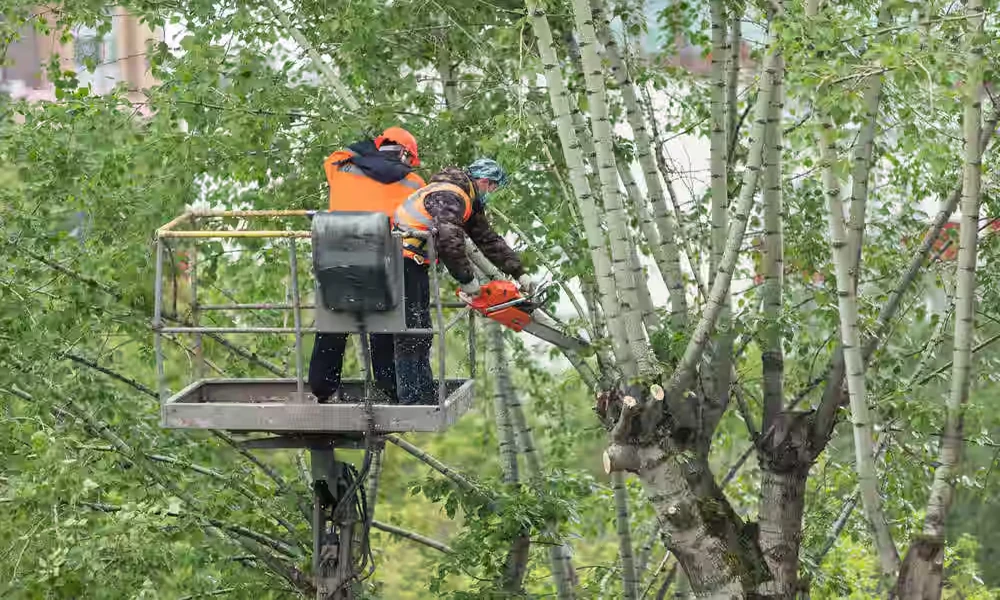
For commercial tree removal, the most efficient solution is often night or weekend work, allowing the job to be completed outside trading hours. Boom lifts and aerial platforms can be brought in when space allows, accelerating the work significantly compared to pure manual climbing. Stump grinding and surface restoration are completed before business resumes.
The permit question is no less important in commercial settings. Trees in gazetted areas of commercial developments are subject to the same Parks and Trees Act provisions as those in residential properties. A company managing a commercial estate that removes a protected tree without approval faces the same fifty thousand dollar fine as an individual homeowner, without the benefit of ignorance as mitigation.
“The measure of a good organisation is how it handles things when they go wrong,” Goh Chok Tong said. Engaging a qualified tree removal company with proper permit management removes a significant category of things that can go wrong.
What Both Settings Share
Regardless of whether the removal is residential or commercial, several requirements are consistent. The tree’s regulatory status must be confirmed before work begins. The removal methodology must account for the specific site constraints. A qualified climber or arborist must be present throughout. The client must receive documentation confirming the work was completed in compliance with applicable rules.
Tree removal companies that operate across both residential and commercial settings bring a flexibility of approach and equipment that specialists in only one setting cannot match. They have dealt with the tight gate at the landed property and the night shift at the commercial centre. They know which situations require creative solutions and have the equipment and trained personnel to deliver them.
After the Tree Is Gone
Site restoration after tree removal matters as much as the removal itself. Stumps left at ground level are trip hazards and will sprout new growth. Grinding the stump below surface level allows the area to be replanted, paved, or returned to lawn without ongoing maintenance of a persistent stump.
Root systems left in place will decay over several years, creating subsidence risk in some soil types. For trees removed near foundations or paved areas, excavation of the major root structure and backfilling with compacted material may be advisable to prevent future ground movement.
Tree cutting companies experienced in Singapore’s soil conditions and typical property configurations will flag these considerations during the site assessment, before removal rather than after it.
For property owners and facilities managers in Singapore who need tree removal handled correctly the first time, working with qualified tree cutting professionals across both residential and commercial settings is the approach that delivers results without regulatory or liability surprises.